Why Is My Water Heater Relief Valve Leaking—and Do I Need a New Water Heater?
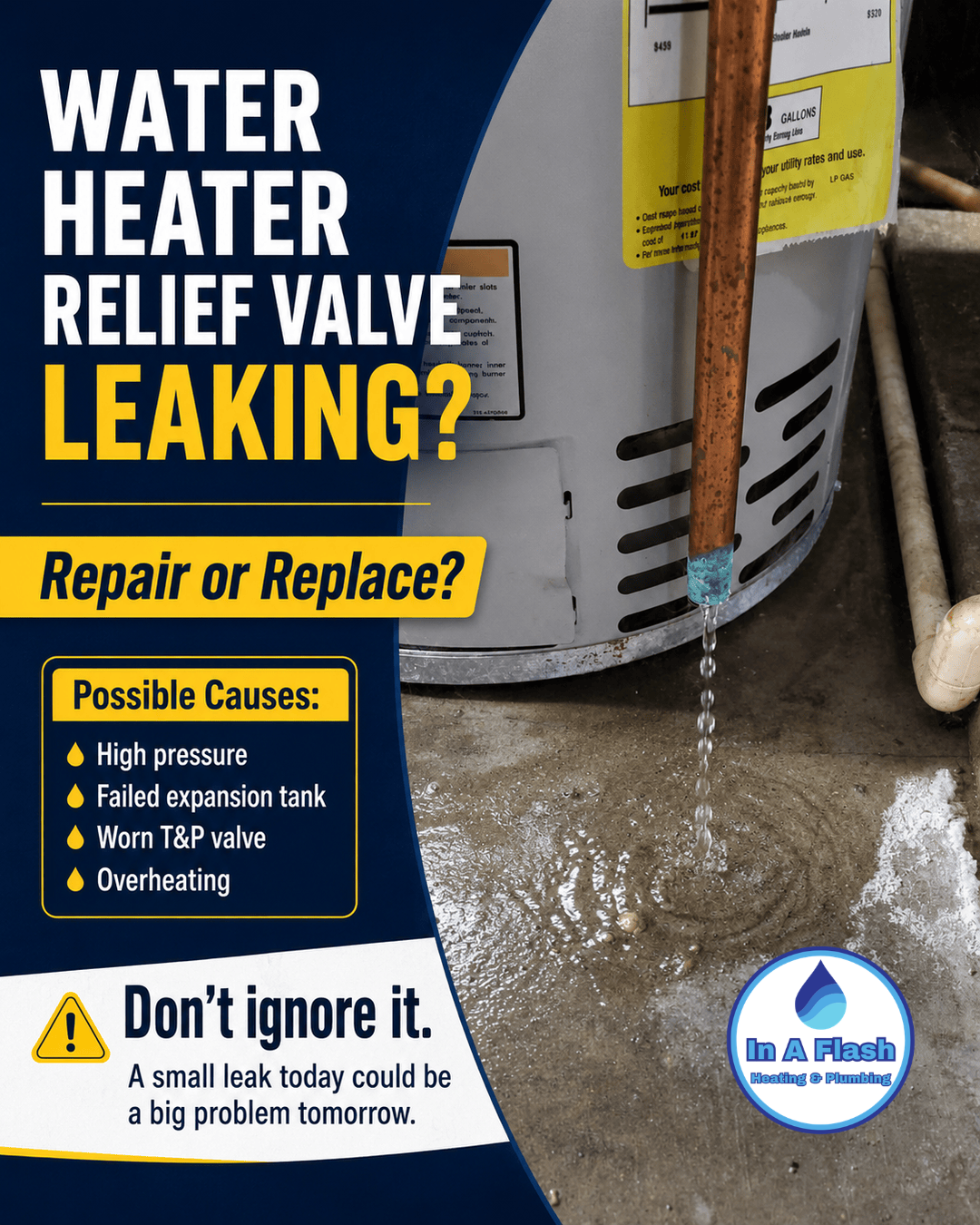
Discovering water dripping from the pipe connected to your water heater’s relief valve can be concerning. Homeowners often wonder whether the valve simply needs to be replaced—or whether the entire water heater is beginning to fail.
The honest answer is that it depends on why the valve is leaking and the overall condition of the water heater.
Sometimes the problem is limited to a worn relief valve, excessive water pressure, or a failed expansion tank. However, when the water heater is older, corroded, or already experiencing other problems, replacing the entire unit may be the safer and more cost-effective decision.
Here is what Massachusetts homeowners should know before deciding whether to repair or replace their water heater.
What Is the Water Heater Relief Valve?
The temperature-and-pressure relief valve—commonly called the T&P valve—is an important safety device installed on a tank-style water heater.
Its purpose is to release water if the temperature or pressure inside the tank rises beyond safe operating levels. This helps protect the tank from dangerous pressure buildup. Because of its safety role, the valve and its discharge pipe should never be capped, blocked, or plugged.
The valve is generally located near the top or side of the water heater and has a pipe extending downward toward the floor.
Why Is My Water Heater Relief Valve Leaking?
Several different problems can cause water to drip or discharge from the relief valve.
Excessive Water Pressure
If the incoming water pressure inside the home is too high, the relief valve may open to reduce pressure inside the tank.
The valve may be doing exactly what it was designed to do. In this situation, simply replacing the valve without correcting the pressure problem may result in the new valve leaking as well.
A plumber can test the home’s water pressure and inspect the pressure-reducing valve, if one is installed.
Thermal Expansion
Water expands as it heats.
In a closed plumbing system, that additional volume may have nowhere to go. Pressure then builds inside the water heater until the relief valve begins dripping.
Thermal expansion is commonly managed with a properly sized and functioning potable-water expansion tank. Manufacturers specifically warn that replacing the relief valve alone will not correct an unresolved thermal-expansion problem.
A Failed Expansion Tank
Even when an expansion tank is installed, it can eventually lose its air charge, develop a damaged bladder, or become waterlogged.
When this happens, it can no longer absorb the expansion created as the water heats. The relief valve may then begin dripping during or shortly after a heating cycle.
A Worn or Damaged Relief Valve
The valve itself may be worn, corroded, contaminated with mineral deposits, or unable to reseal completely.
In that situation, replacing the relief valve may solve the problem—but only after the water pressure, expansion tank, and operating temperature have also been checked.
Excessive Water Temperature
A larger or more forceful discharge may indicate that the water inside the tank is becoming dangerously hot.
This could point to a thermostat, gas control, heating element, or another operating-control problem. Discharge caused by excessive temperature requires prompt professional attention.
Does a Leaking Relief Valve Mean the Entire Water Heater Must Be Replaced?
Not always.
A relief-valve leak does not automatically mean the tank itself has failed. However, the age and condition of the water heater should be considered before investing in repairs.
Repair May Make Sense When:
The water heater is relatively new.
The tank itself is not leaking.
There is no significant rust or corrosion.
The problem is traced to a replaceable relief valve.
Excessive pressure or thermal expansion can be corrected.
The water heater has otherwise been operating reliably.
In these situations, replacing the valve, repairing the expansion system, or correcting the home’s water pressure may restore normal operation.
Full Replacement May Be the Better Option When:
Water is leaking from the tank body or a tank seam.
There is visible corrosion around the tank or valve opening.
The water heater is near or beyond its expected service life.
The unit has needed several recent repairs.
The heater is also producing rusty water, unusual noises, or inconsistent hot water.
The repair cost is difficult to justify compared with a new system.
There are signs of overheating or damage caused by excessive pressure.
Traditional tank-style water heaters commonly have an expected service life of approximately 8–12 years, although maintenance, water quality, installation, and usage all affect how long an individual unit lasts.
When an older heater develops a leaking relief valve along with corrosion or other problems, replacing the entire water heater often makes more financial sense than continuing to replace individual components.
Is the Water Coming From the Valve or the Tank?
Correctly identifying the source of the water is extremely important.
Water traveling down the relief-valve discharge pipe may indicate:
Relief-valve activation
A worn valve
Excessive pressure
Thermal expansion
Excessive water temperature
Water leaking directly from the tank body, bottom seam, or a corroded section of the tank usually points to a failed storage tank.
A failed tank cannot normally be repaired reliably. In that situation, the water heater will need to be replaced.
Because water can travel across pipes and surfaces before reaching the floor, the visible puddle may not be directly below the actual source.
What Should You Do If the Relief Valve Is Leaking?
Do not cap, plug, or install a shutoff on the relief-valve discharge pipe. Blocking it can prevent the water heater from safely releasing excessive temperature or pressure.
Homeowners should also avoid touching discharged water because it may be extremely hot.
A licensed plumber can inspect:
The relief valve
The water heater tank
Incoming water pressure
The pressure-reducing valve
The expansion tank
The thermostat or operating controls
The temperature of the stored water
This allows the underlying cause to be corrected rather than replacing parts without knowing why the valve opened.
Repairing an Old Water Heater Versus Replacing It
Repairing a younger water heater with a confirmed valve or expansion problem can be reasonable.
However, repeatedly investing in an aging, corroded, or unreliable tank can become expensive. Even after one component is replaced, another aging part—or the tank itself—may fail shortly afterward.
A professional evaluation should consider:
The age of the heater
The source of the leak
The condition of the tank
The repair history
The warranty status
The cost of repair compared with replacement
The household’s current hot-water needs
This provides a more complete answer than automatically replacing either the relief valve or the entire water heater.
Water Heater Repair and Replacement in Medford and Greater Boston
At In A Flash Heating & Plumbing, we help homeowners determine whether a leaking water heater can be repaired safely or whether replacement is the better long-term option.
We provide water heater diagnostics, repair, installation, and replacement throughout Medford, Somerville, Malden, Everett, Cambridge, Arlington, Melrose, Winchester, and surrounding Greater Boston communities.
If your water heater’s relief valve is dripping, releasing water, or creating a puddle near the tank, do not ignore it. The leak may be caused by a replaceable component, but it may also be warning you about excessive pressure, overheating, or an aging water heater.
Call In A Flash Heating & Plumbing at 781-572-2575 to have the system professionally evaluated.
Frequently Asked Questions
Can I replace only the water heater relief valve?
Yes, if testing confirms that the valve itself has failed and the water heater is otherwise in good condition. Water pressure and thermal expansion should also be checked so the replacement valve does not begin leaking again.
Why does the relief valve leak only when the water heater is heating?
A leak that occurs during heating cycles may be caused by thermal expansion. As the water heats and expands, pressure can increase inside a closed plumbing system.
Can a failed expansion tank cause the relief valve to leak?
Yes. A failed or waterlogged expansion tank may no longer absorb the increased water volume created during heating, causing pressure to rise and the relief valve to discharge.
Does a leaking water heater tank need to be replaced?
Generally, yes. If the tank body or tank seam itself is leaking, the storage tank has usually failed and cannot be repaired reliably.
Is a leaking relief valve dangerous?
traditional tank-style water heatersIt can indicate excessive pressure or temperature, so it should not be ignored. The valve is a safety device, and any continuous or forceful discharge should be evaluated promptly by a licensed plumber.